
What is Process Control?
Process control is the deliberate alteration of a process in response to process monitoring data. The process owner makes an adjustment to bring the process back under control once the process monitoring tools have identified an out-of-control scenario.
Although various techniques are employed to manage these processes, this monitoring and management are collectively referred to as process control.
Control Types
Self-Regulating Process
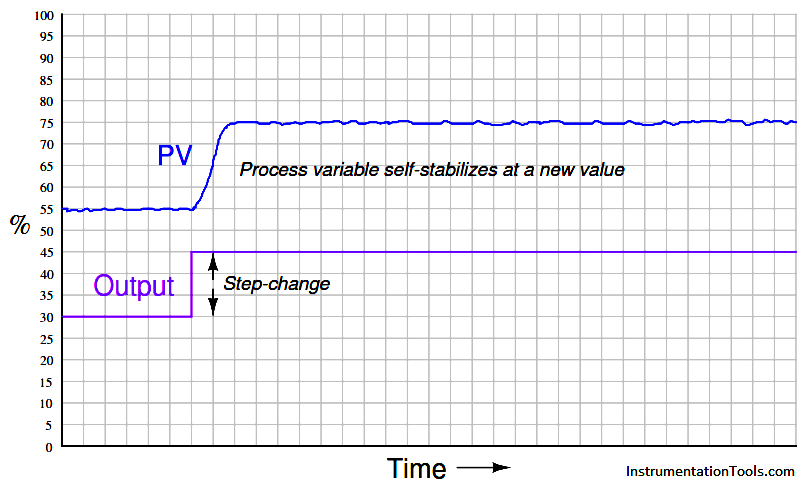
Time Constants
Process Gain
The process' capacity and reluctance to change have an impact on the time constant. The time constant increases with processing capacity and decreases with the number of resistive elements (small pipes, penetrations, valves, etc.) in the process.
Dead Time
Non-Self-Regulating Process
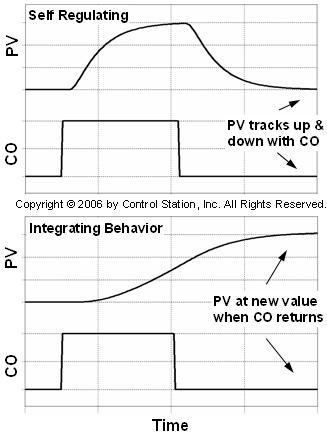
A process that does not have a tendency toward self-regulation is said to be non-self-regulating. These processes lack any self-regulating feedback qualities and have the propensity to become unstable without external regulation.
Process Control Terminology
The figure below shows the numerous parts that make up a control system. Each of these elements has distinct properties, and altering any one of them can alter the control loop's overall reaction.
Controlled Variable
A process parameter is regulated by the controlled variable. The controlled variable in this example is the water level in the tank, but you may choose to control any process instead.
Measured Variable
The electrical or pneumatic representation of a controlled variable's value is referred to as a measured variable. Usually, a transmitter is used to measure the controlled variable and provide an output that is a representation of it.
Setpoint
The measured variable is forwarded to the loop's controller, where it is contrasted with the setpoint, a target value. A comparison is performed between the setpoint and the measured variable to provide an error signal. Operators frequently manually enter the setpoint, but it can also be automatically retrieved from other systems. With the letter "r," setpoint is denoted.
Error Signal
Controller Output
The controller output is just the sum of the controller's outputs. The output is determined by the controller when it is set to automatic. The output may be manually changed to any desired location if the controller is set to manual. The letter "p" stands for controller output.
Comments
Post a Comment